IDEAS Lab
How might we design a space
where technology and people
evolve together?
ROLE
UX
Researcher
TEAM
6
RESEARCHERS
DURATION
6 months
STATUS
Architect
study
OVERVIEW
A library floor, reimagined
for what comes next.
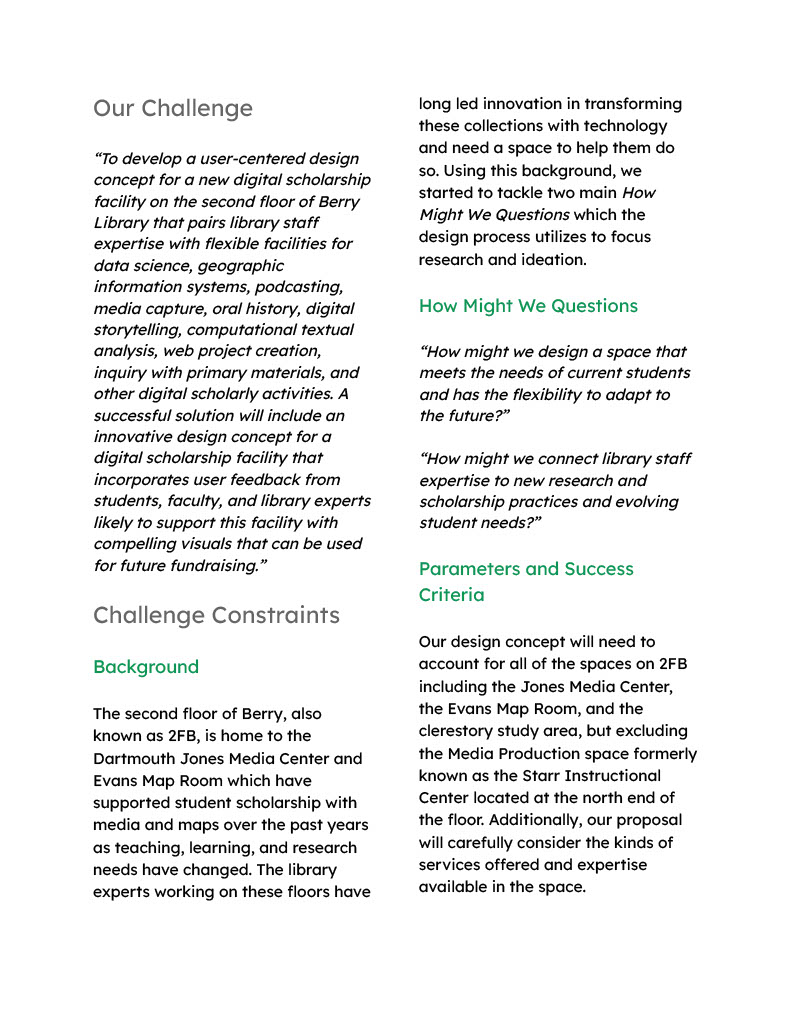
Dartmouth's Berry Library second floor (2FB) had served its users faithfully — but quietly, the space had grown out of step with how people actually work, collaborate, and learn.
The Jones Media Center, Evans Map Room, and student study areas occupied the floor organically over time. No single system held them together. The result: resources that went undiscovered, staff who lacked dedicated workspace, and students who couldn't access the floor after 5pm.
IDEAS Lab is the proposed reimagining of 2FB as a unified multimedia facility — a space built for podcasting, GIS, video production, data science, and primary source research, with the flexibility to adapt as technology and pedagogy evolve.
Design System
Research Synthesis
Information Architecture
Systems Mapping
User Testing
Status: Architect-led Feasibility Study
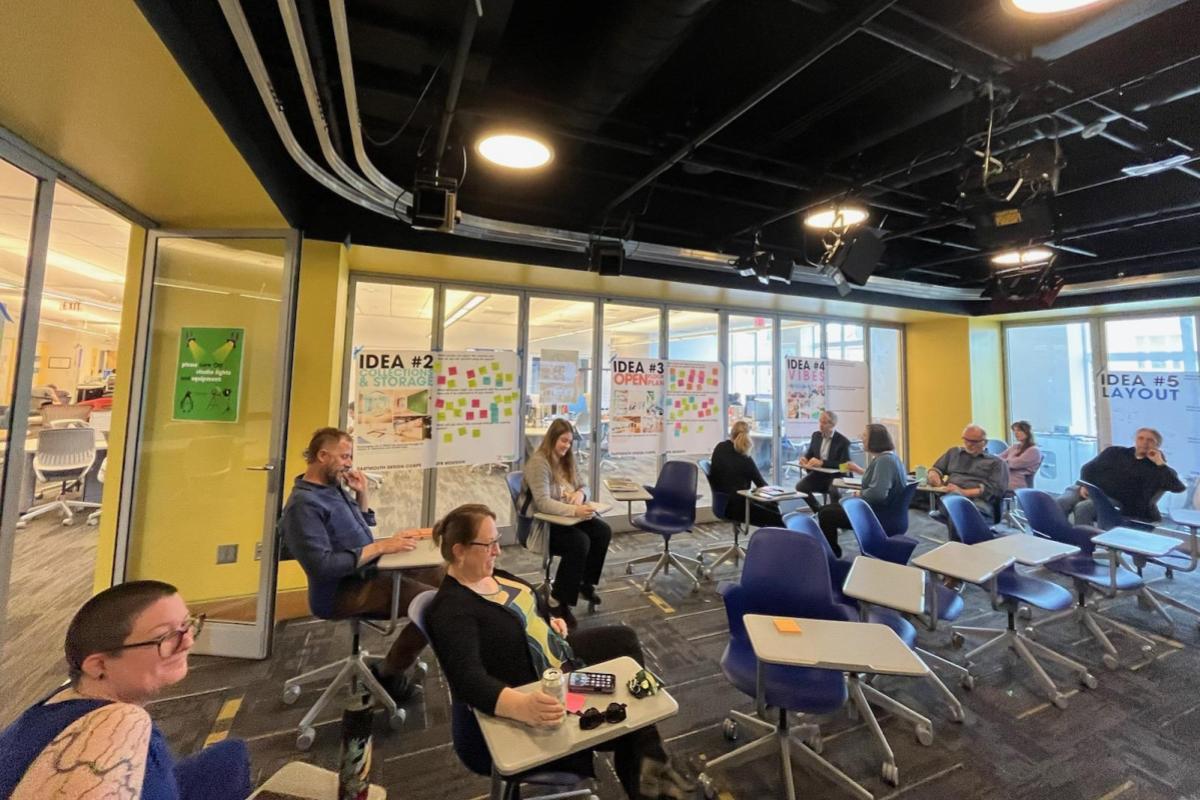
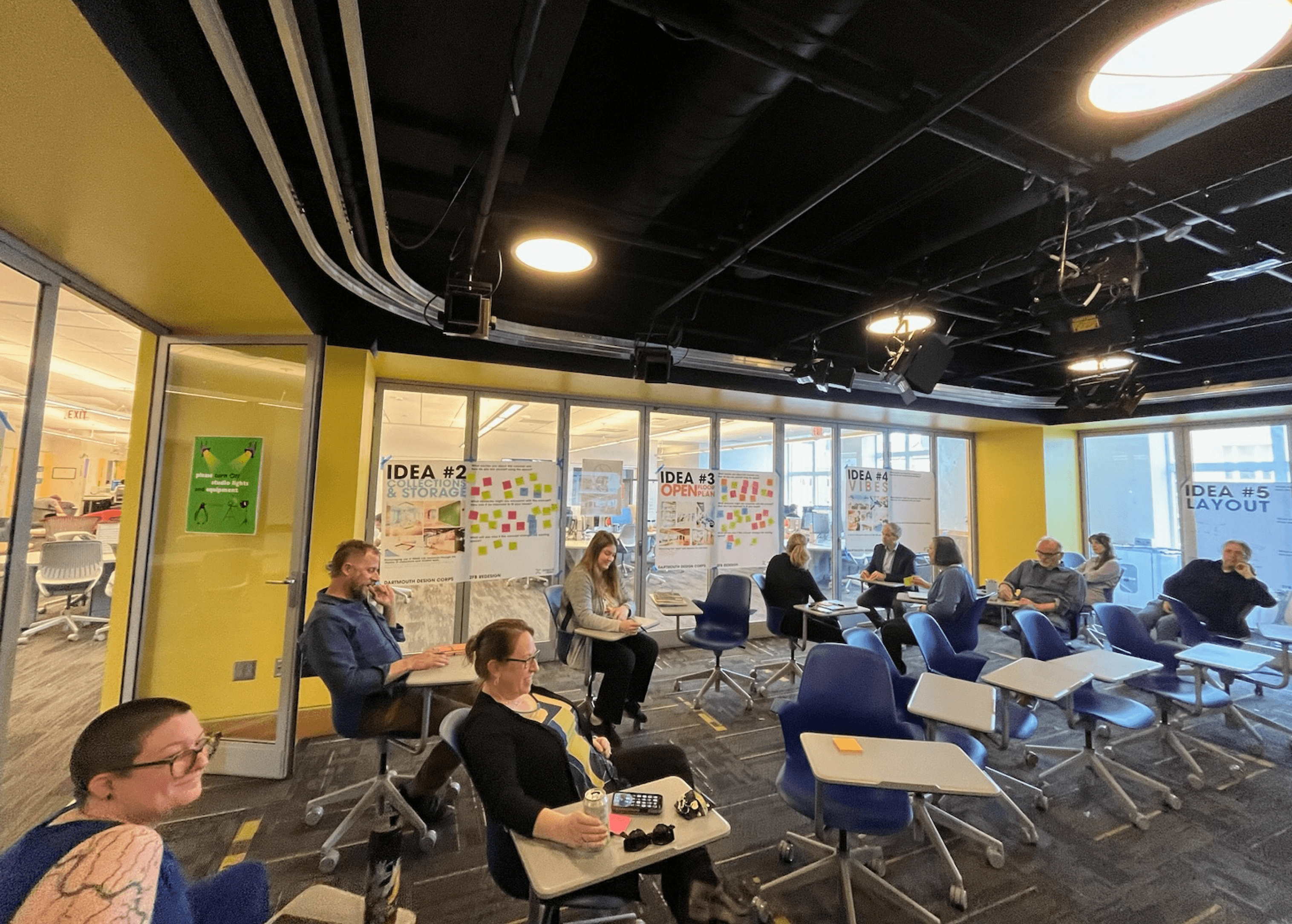
design feedback workshop with library staff!
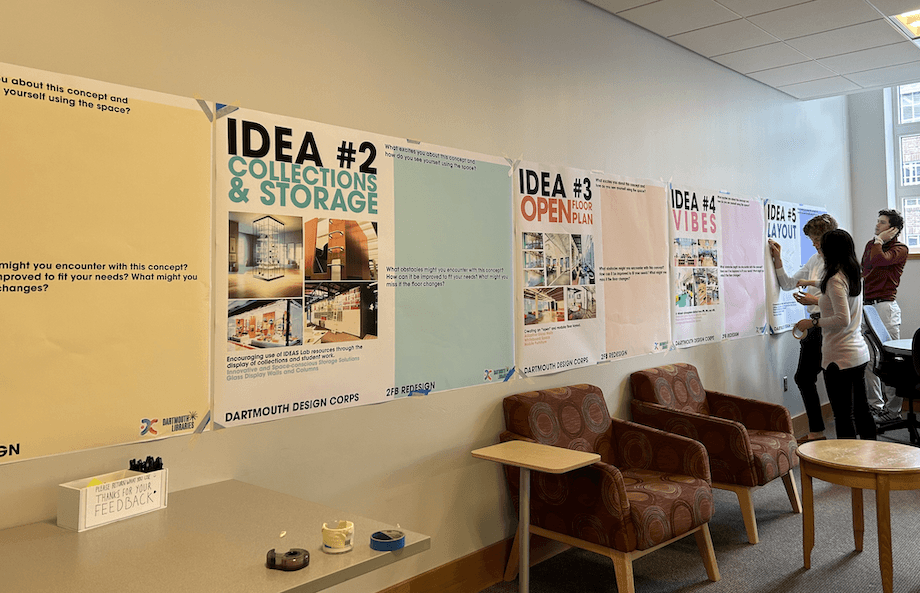
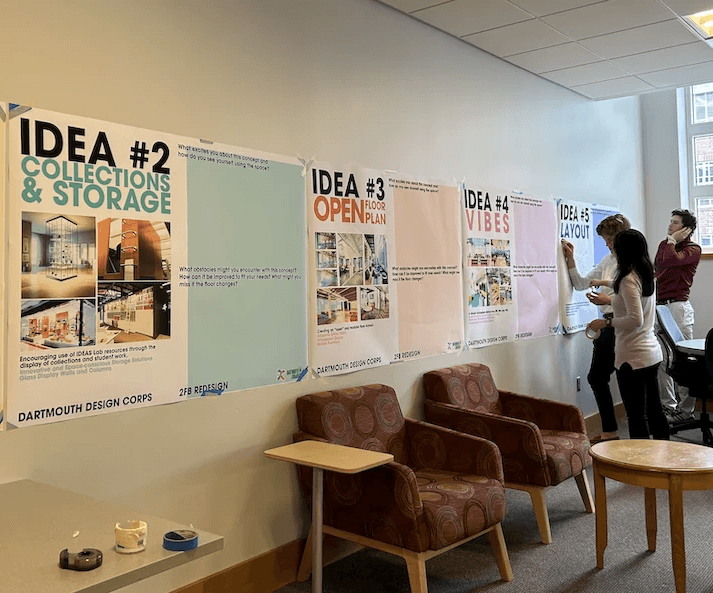
setting up our feedback posters in the library!
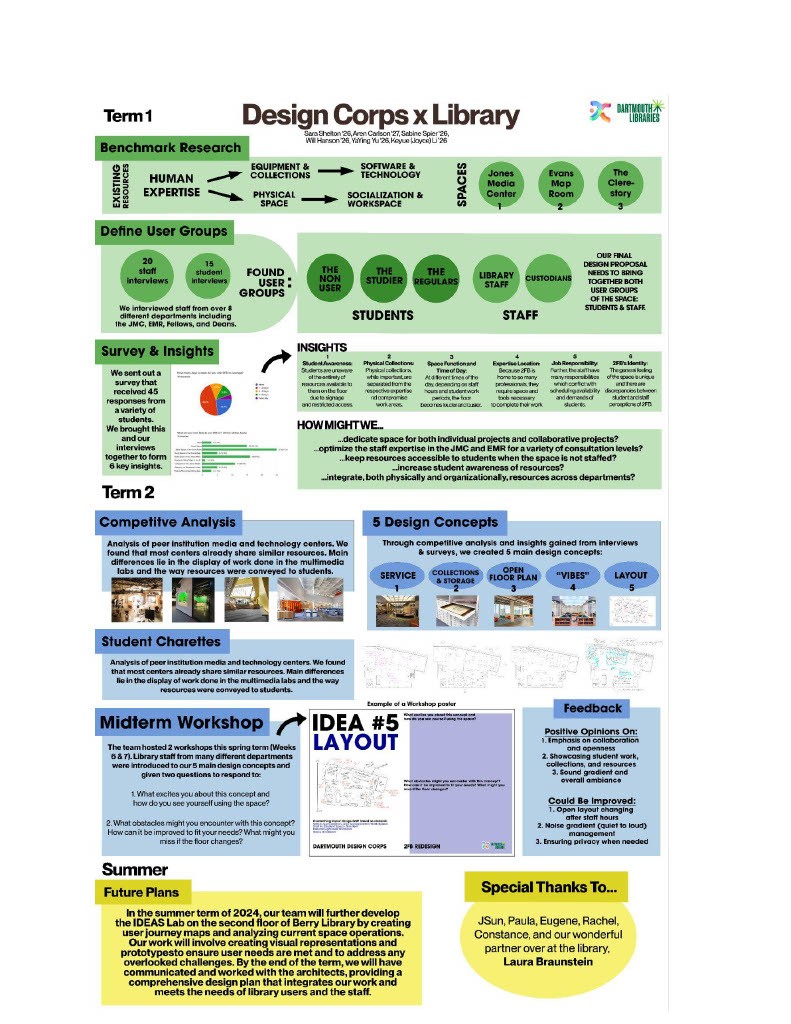
FINAL DELIVERABLE
33-page project report
A whole floor, redesigned.
We presented a 33-page project report proposing key design principles, spatial concepts, and feature recommendations for the new IDEAS Lab. Every recommendation was grounded in both user and industry research — interviews, surveys, design charrettes, competitive analysis, user personas, and journey maps.
The report was taken to Campus Planning Operations to support funding advocacy, and has taken the project to an architect-led feasibility study.
“Thank you for the amazing collaboration. Working with
the team was one of
the best experiences of
my career at Dartmouth!”
Laura Braunstein
Head of Digital Scholarly Engagement
Dartmouth College
PROJECT CONTEXT
A floor that grew beyond
what it was built for.
2FB currently houses the Jones Media Center, Evans Map Room, and student study areas — each added organically over time.
The systems originally put in place no longer match how students, staff, and faculty actually work. Half the floor is restricted after 5pm due to collection storage, cutting off potential study areas during peak student hours. Staff lacked dedicated workspace separate from student support. Collections were stored apart from the expertise associated with them. Furthermore, with the rapid change in media and technology over the last decade, these student resources were no longer fit for purpose.
Dartmouth Libraries envisioned IDEAS Lab — a unified digital multimedia facility — to resolve these tensions and future-proof the space for technologies and pedagogies that don't yet exist.
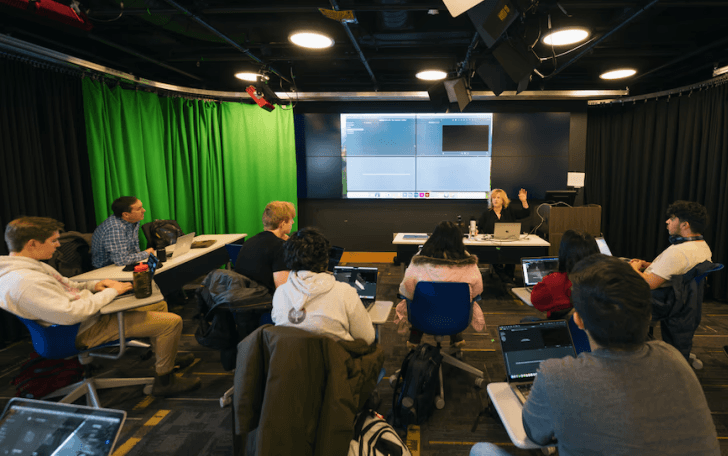
How might we design a space that meets students’ collaboration needs
while adapting to evolving technologies and media?
DESIGN PROCESS
01
Research & Synthesis
Stakeholder interviews, surveys, and systems mapping to understand the full user landscape and space constraints.
02
Information architecture
Benchmarking peer institutions to
surface what spatial and operational patterns actually work in multimedia library contexts.
03
Redesign & Testing
Five spatial design concepts grounded in research, validated through workshop sessions and student poster feedback.
04
Implementation
A comprehensive deliverable equipping campus planners and architects with student-informed design criteria.
USER RESEARCH
We didn't assume,
we listened first.
Mixed methods research
Over two terms, we conducted a structured research cycle designed to iteratively validate findings and dig deeper at each round. The goal was to let the evidence converge on what users actually needed and not what we suspected.
STAKEHOLDER INTERVIEWS
Semi-structured conversations
Interviews with library staff, students across all class years, and faculty — capturing how eachgroup uses and perceives the space today.
QUANTITATIVE SURVEYS
Usage patterns at scale
Survey data surfaced frequency, purpose, and preference signals across a broader population than interviews alone could reach.
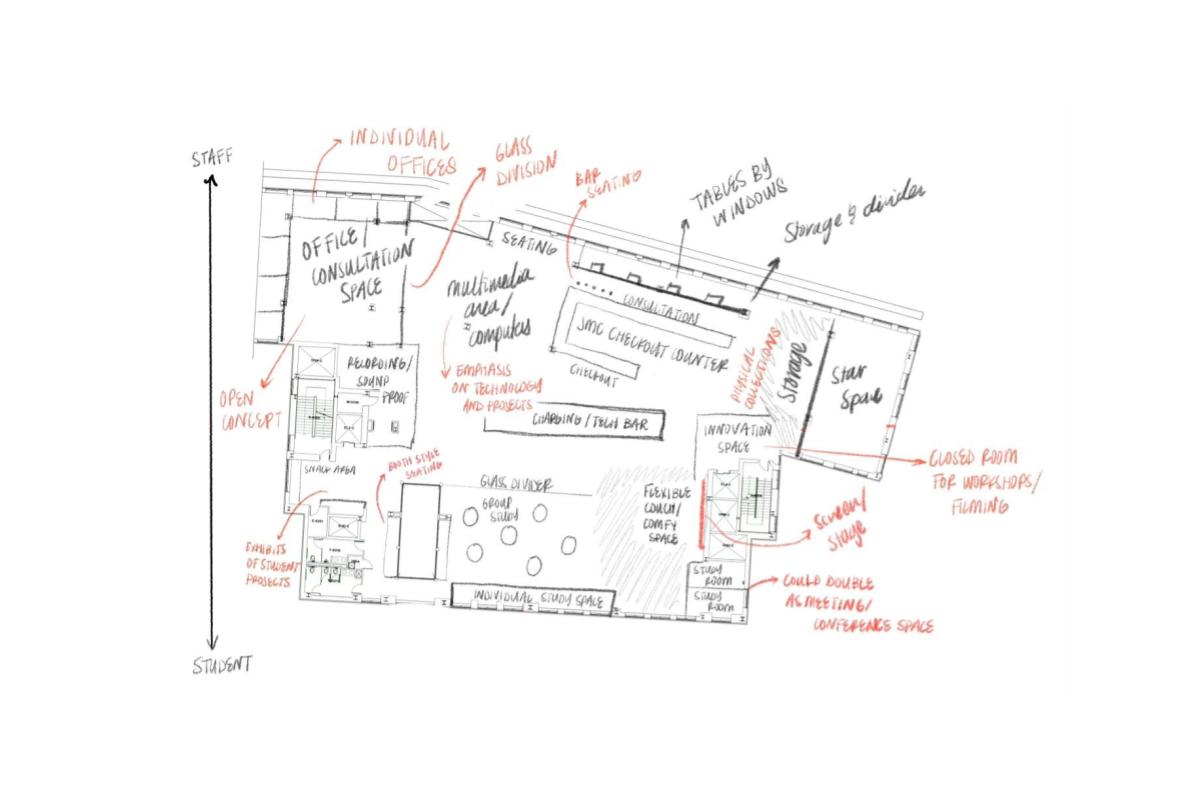
DESIGN CHARRETTES
Floor plans from users
We asked both regular users and non-users to sketch how they imagined the floor could work , revealing assumptions we hadn't considered.
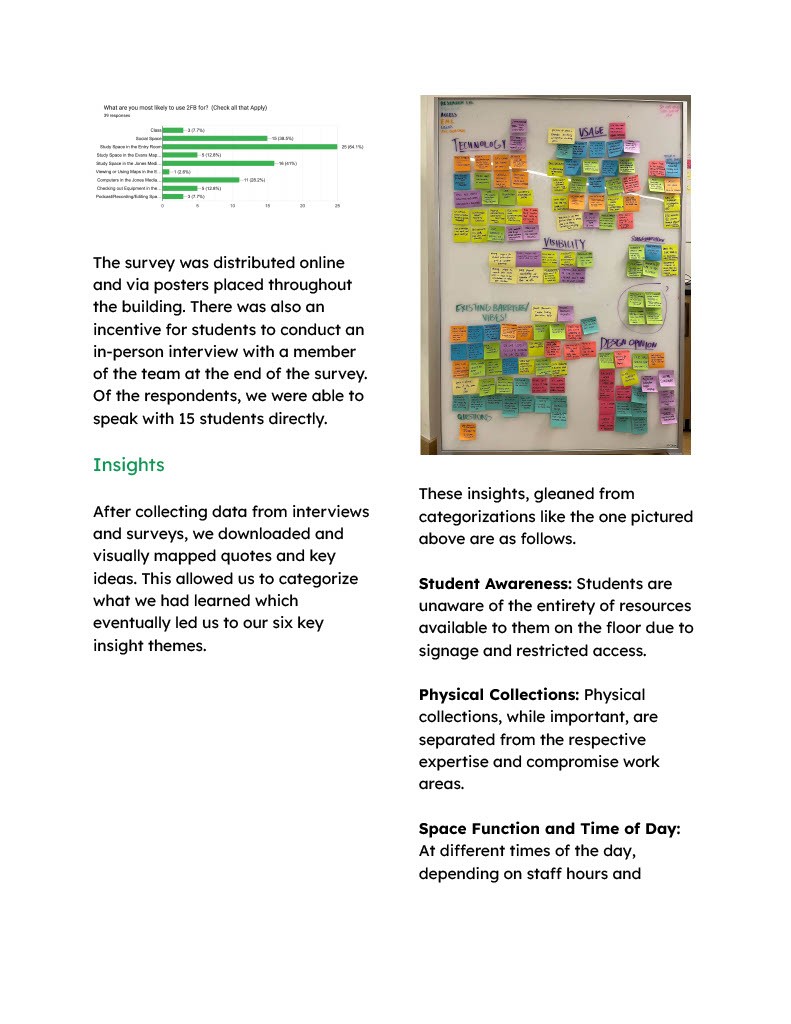
Insight synthesis
After rounds of coding and affinity mapping, we identified six emergent themes that cut across all three user groups. These became the foundation for every design decision that followed.
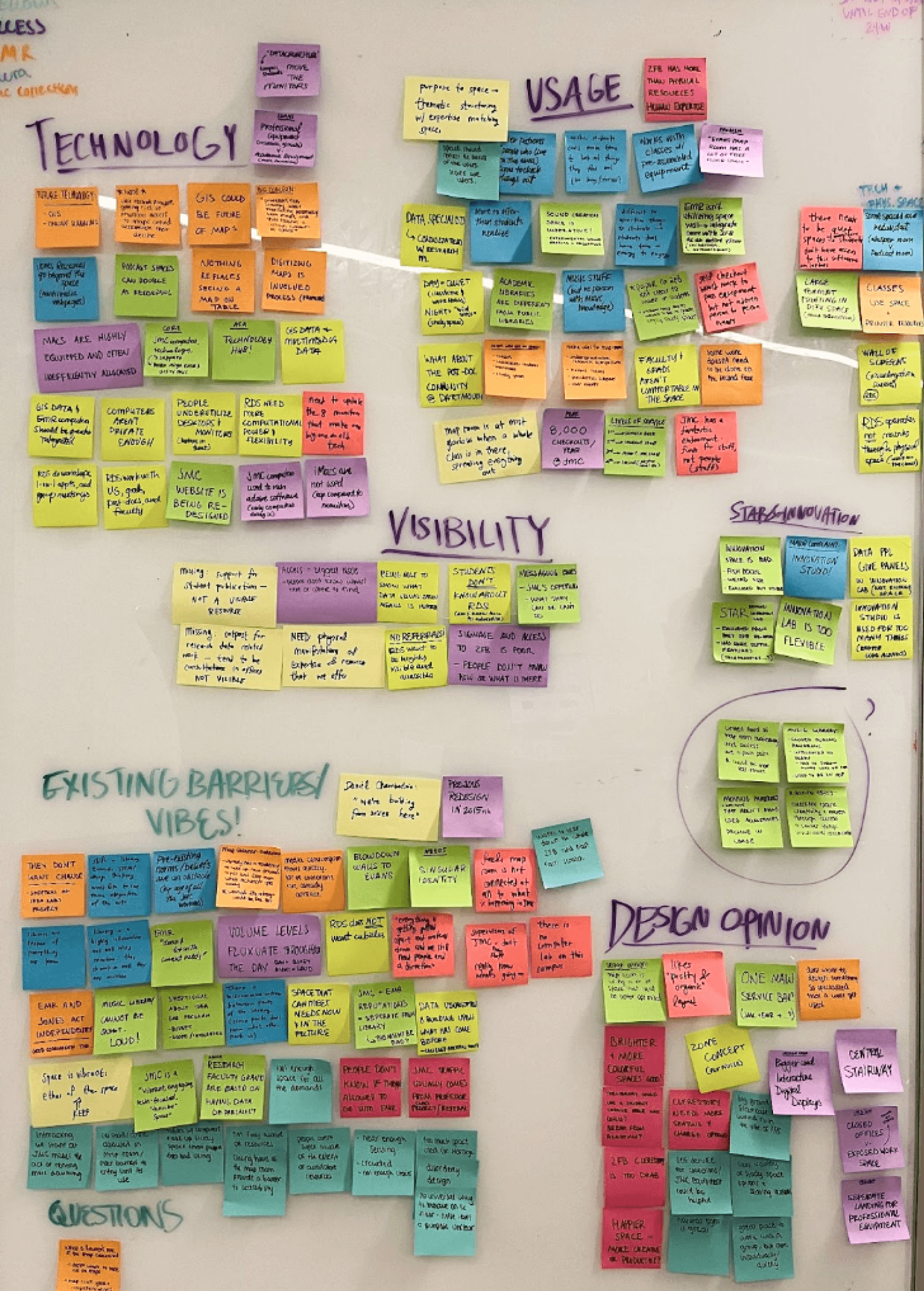
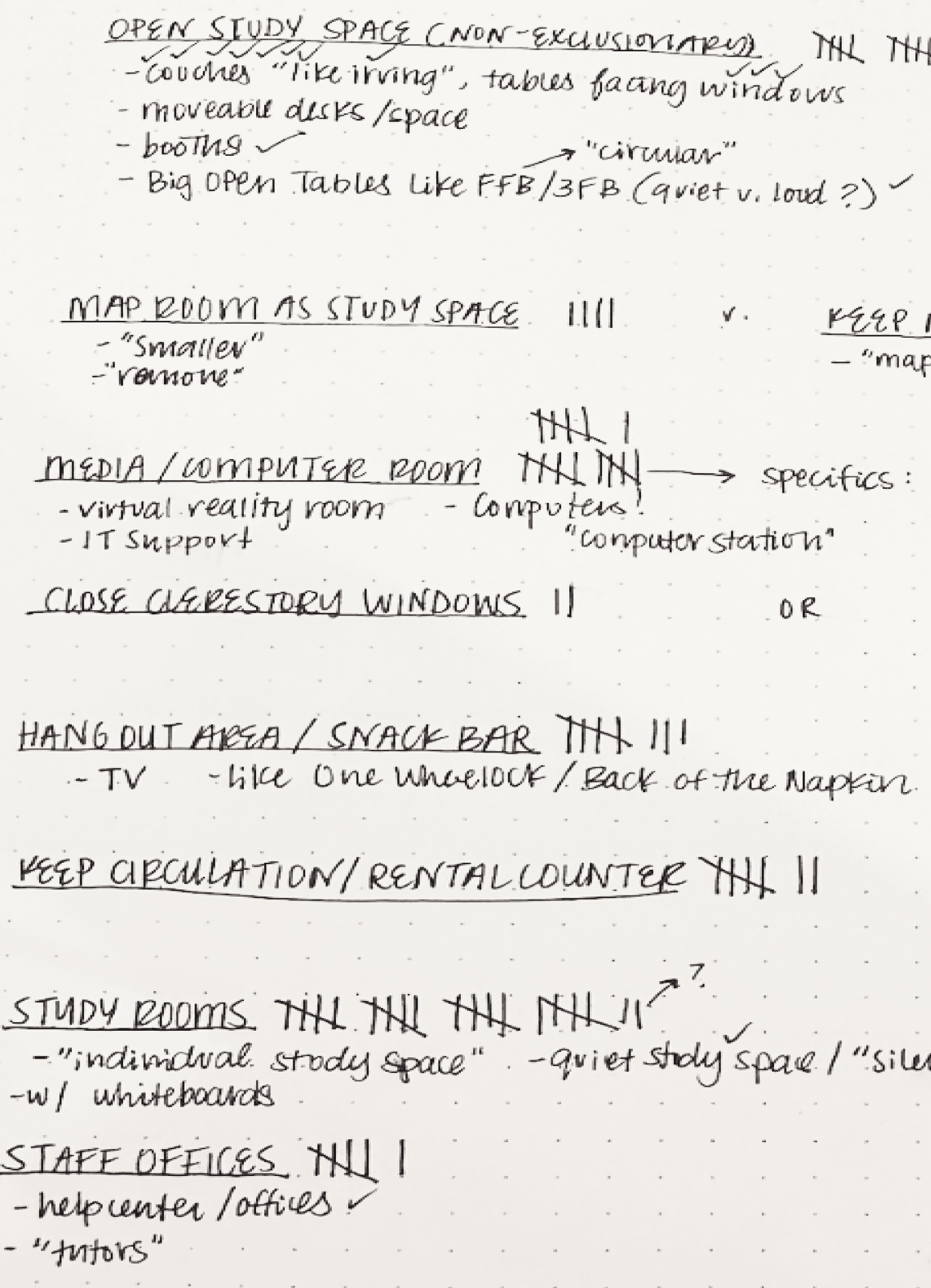
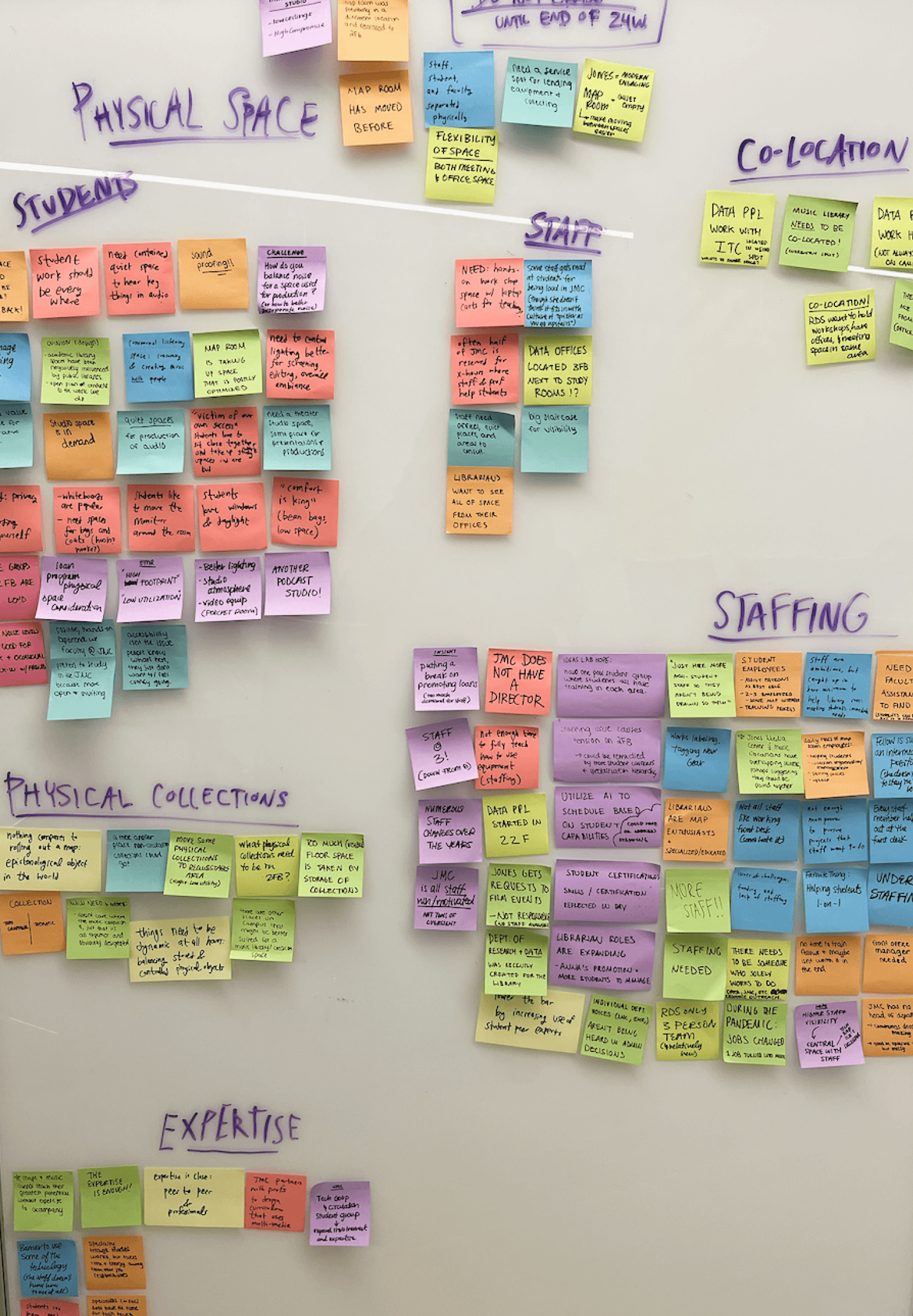
A snapshot of our affinity mapping and insight synthesis sessions.
KEY FINDINGS
The space could no longer support
the people using it.
Six structural themes emerged from our research — each pointing to a mismatch between the floor's original design intent and the range of needs it was now expected to serve.
Low student awareness
Students were unaware of the resources and collections available in the space — not because they didn't care, but because nothing reached them.
Conflicting availability
Busy schedules on both sides made 1-on-1 student-staff support sessions consistently difficult to coordinate.
Collection-work division
Physical collections were stored separate from the expertise associated with them, fragmenting workflows for both staff and students.
Time-restricted access
Collection storage blocked half the floor after 5pm, cutting off potential study and collaboration areas during peak student hours.
Distinct space identity
Regular users recognized and valued the unique character of the floor — a quality any redesign needed to preserve.
Staff workspace gaps
Staff lacked dedicated space to focus on their own work independently from student support — creating constant context-switching.
When 2FB was originally designed, it was not built to support the range of staff, students, and technologies it now serves. The space had grown past its original brief and every finding pointed back to that structural mismatch.
It wasn’t a resource problem, but
a structural one.
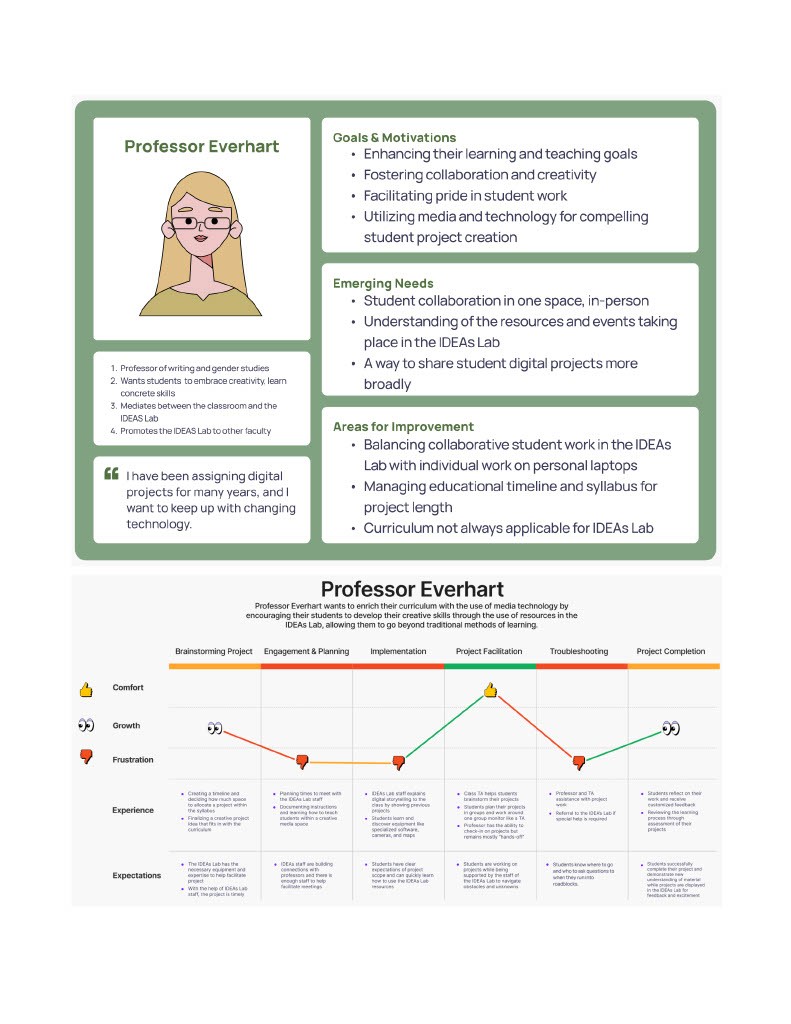
User personas
We built six personas from our research, spanning faculty, graduate students, undergraduates, library staff, and specialists. Each represents a distinct relationship to the floor in its current state and a different set of needs the IDEAS Lab would need to serve simultaneously.
Note: Below are simplified versions of the user personas found on the final report.
FACULTY • SOCIOLOGY PROFESSOR
Camille Earhart
"I've been assigning digital projects for many years, and I want to keep up with changing technology."
Integrates IDEAS Lab tools into course curricula and mediates between classroom expectations and equipment she's still learning herself.
UNDERGRADUATE • FIRST-TIME IDEAS LAB USER
Arjun Kapoor
"The media projects are more engaging. I feel like I learn more by being creative with the outcome."
Assigned a media project with no prior experience and is motivated, but struggles navigating equipment and a space with no clear entry point.
Undergraduate · Curious passerby
Miguel Santos
"I have so many ideas for creative projects, but I had never thought about how to actually make it come true."
Engineering student drawn in by student work on display, wondering if the lab could support the creative projects he’s never had space to pursue.
Graduate researcher · Self-directed
Amy Tanaka
"I'm a motivated learner — I need resources and a place to work on a project independently."
Wants to visualize research data for non-academic audiences but is blocked by unclear resource discovery and no quiet independent workspace.
Library staff · Veteran employee
Amara Okoye
"I want to balance a busy service point with more specialized engagement on research projects."
Manages a high-volume service point with deep technical expertise but has no dedicated space to use outside of student support hours.
GIS & Data Specialist · Veteran librarian
Mateo Rossi
"I want to encourage collaborative research work with both physical and digital resources."
Bridges physical collections and data visualization for students and researchers across disciplines — but needs a space designated to that work.
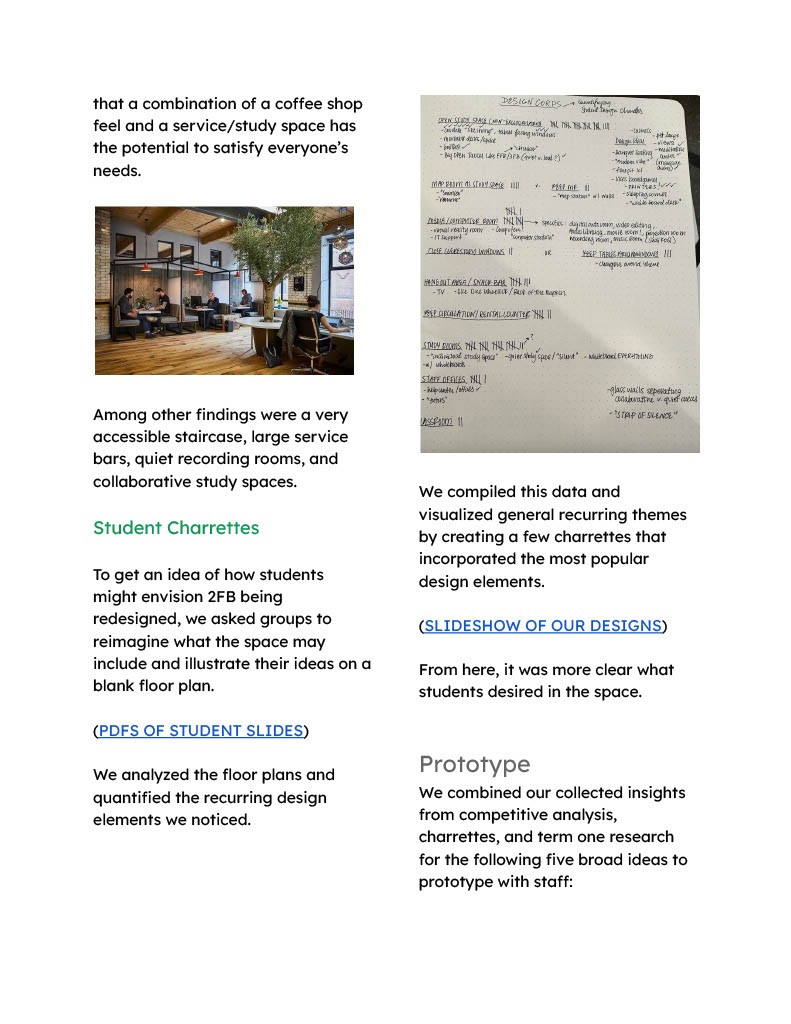
INDUSTRY research
Instead of reinventing the wheel,
we looked for existing success.
We benchmarked multimedia spaces at peer institutions — Carnegie Mellon, Duke, and several Ivy League universities — to understand what spatial and operational patterns actually enabled the kind of collaborative, discovery-driven work IDEAS Lab was meant to support.
What makes other multimedia labs so successful in user experience and what might we learn from them?
We found three main features that stood out at other labs:
CENTRAL SERVICE DESKS
Reducing ambiguity
A clear, visible entry point for students seeking assistance with projects or equipment removed ambiguity and lowered the barrier to asking for help.
OPEN FLOOR PLANS
Inviting collaboration
Glass or flexible walls made spaces feel less compartmentalized and more inviting — signaling that collaboration was welcome, not just tolerated.
PROJECT SHOWCASES
Proximity discovery
Projects and collections in view introduced the space to passersby — turning awareness into a byproduct of proximity rather than requiring deliberate discovery.
PROPOSED FEATURES
Five core concepts
to make a coherent space.
Our user research and market research converged on five spatial design concepts. Each addressed a distinct failure mode in the current floor while collectively pointing toward a unified and adaptable environment.
Service integration
CURRENT PROBLEM
Students unfamiliar with the floor have no legible starting point: multiple departments with no clear front door.
IDEAS LAB SOLUTION
A unified service desk spanning all departments — one place to begin, regardless of what you need or who you need to talk to. The desk makes expertise visible and accessible at a glance.
Noise gradient
CURRENT PROBLEM
Different types of work (quiet solo focus, group collaboration, staff consultations) happen simultaneously on the floor with no spatial logic separating them, creating friction for everyone.
IDEAS LAB SOLUTION
A noise gradient organizes the floor from quiet to collaborative, so every user type has a zone that matches how they work. Users can self-select where to go without enforcing rules nobody will follow.
Open floor plan
CURRENT PROBLEM
2FB is physically small, and its walls and partitions make it feel even smaller. Users described it as cramped and fragmented, a collection of separate rooms rather than a coherent space.
IDEAS LAB SOLUTION
Removing unnecessary partitions and introducing glass walls opens the floor visually, making it feel larger and unified. The goal is one legible space, not a hallway connecting several smaller ones.
Space character
CURRENT PROBLEM
2FB's atmosphere had developed organically, distinctive in ways users valued but never intentionally designed. A renovation risked erasing the character that made the floor feel worth returning to.
IDEAS LAB SOLUTION
A deliberately contemporary aesthetic (bright, plant-filled, "techy") that preserves what users already loved while making it intentional. The floor should feel distinct from the rest of the library, not an extension.
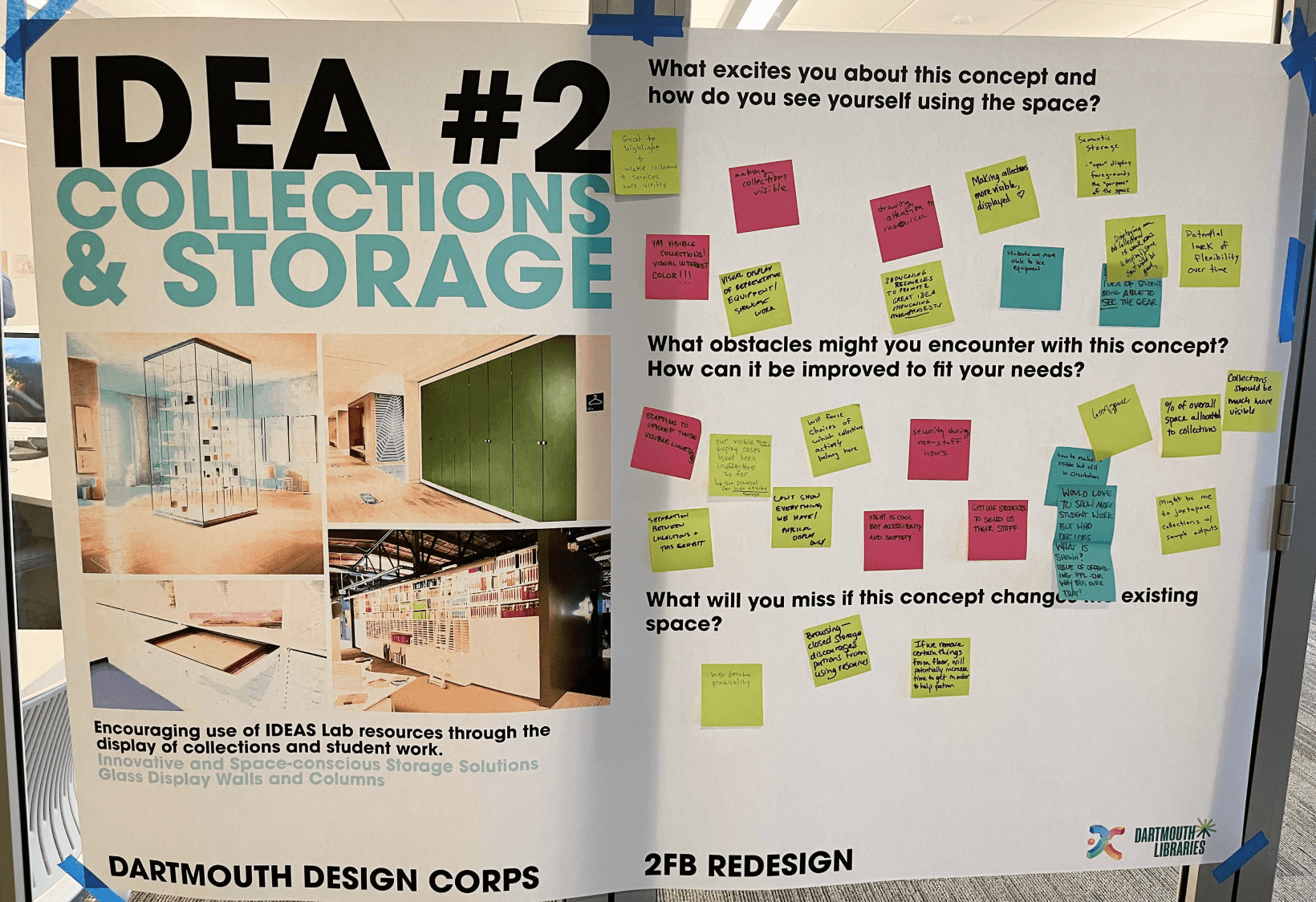
Collections + storage
CURRENT PROBLEM
Students interested in what 2FB offers have no way to discover it. Resources are stored out of sight, separated from the staff expertise that gives them context.
IDEAS LAB SOLUTION
Visible displays of collections and student work surface what exists without requiring prior knowledge. Secure, consolidated storage handles the rest, removing the fragmentation that kept resources invisible.
concept validation
What do our users have to
say?
Staff workshops and student poster feedback
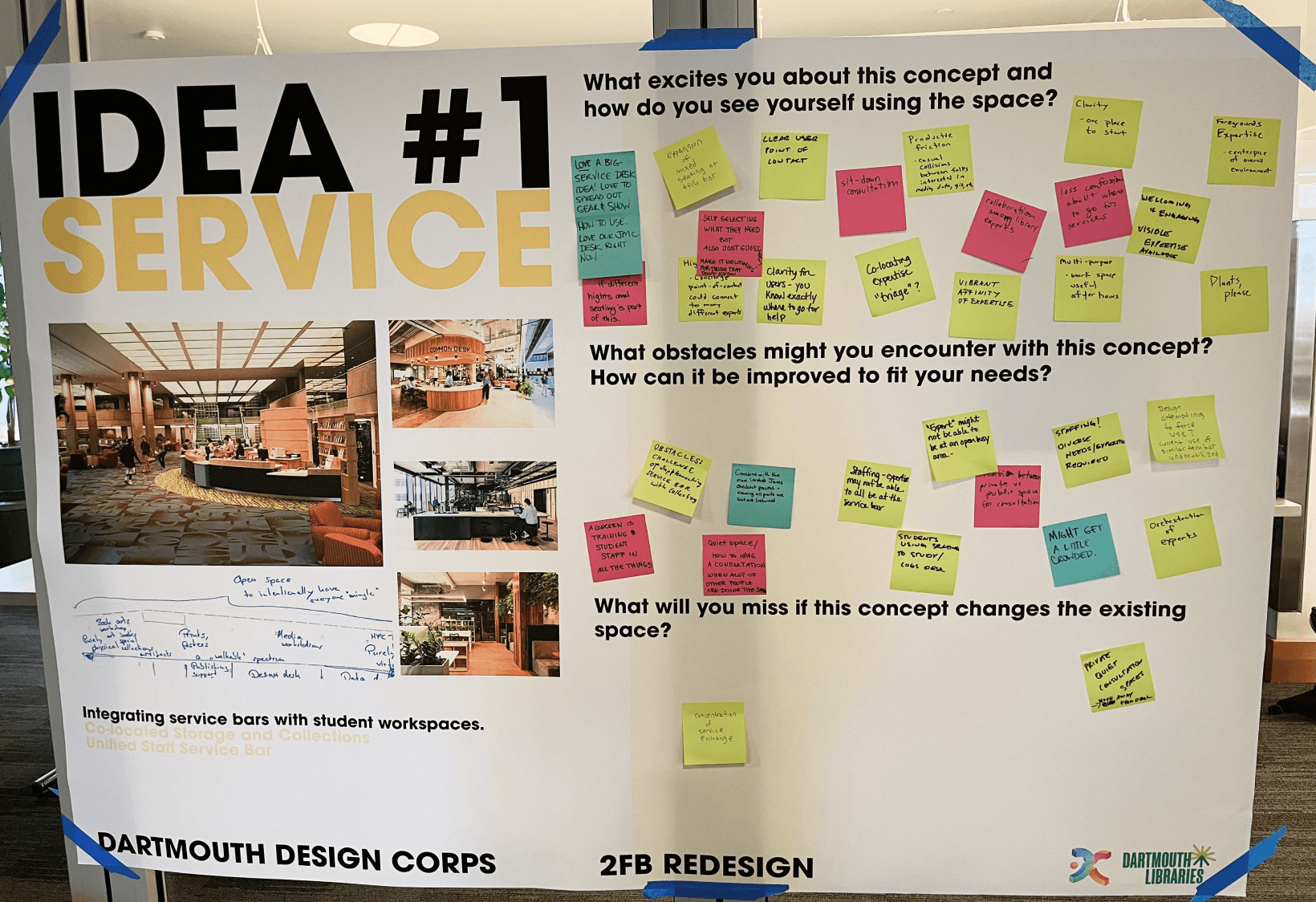
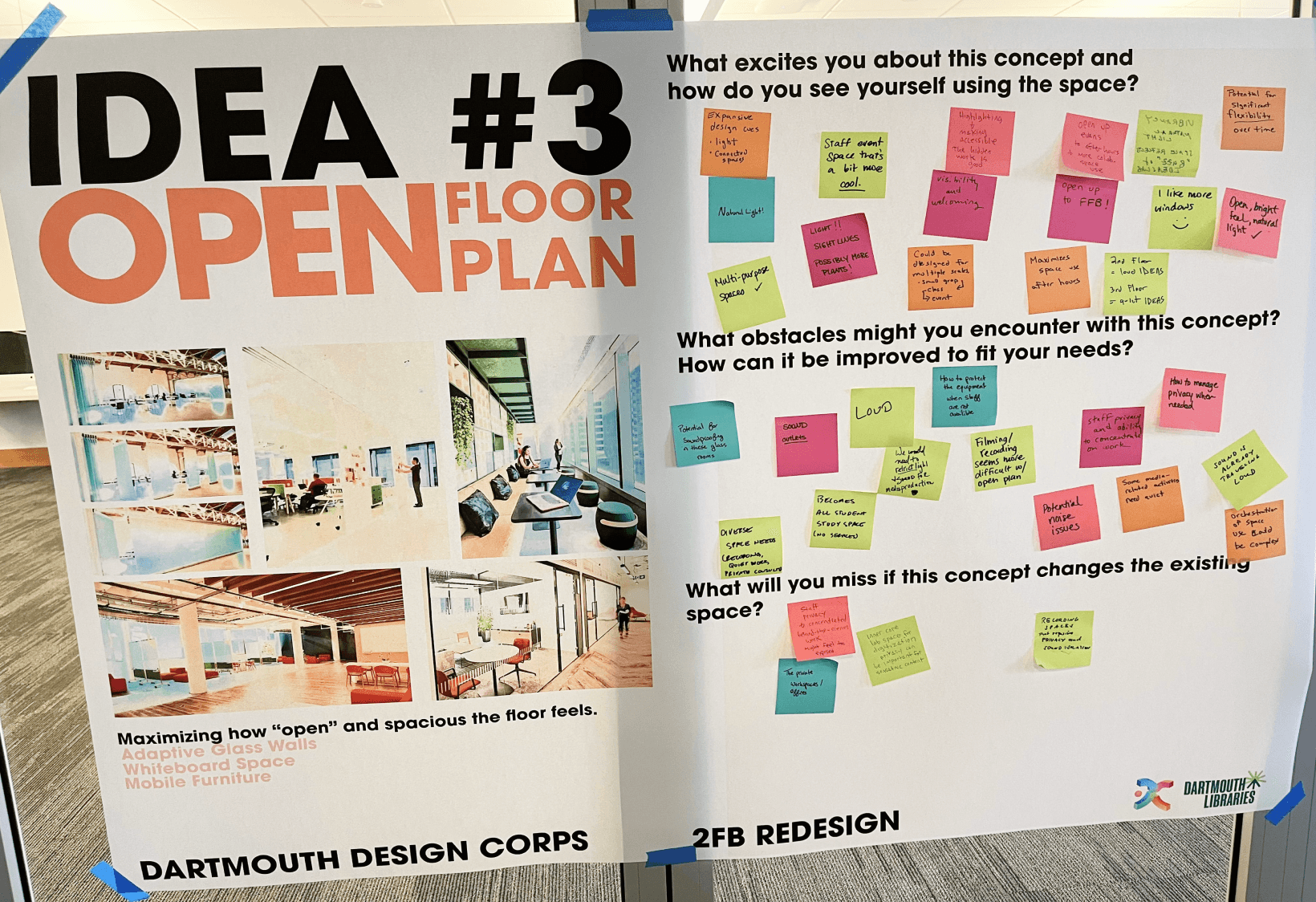
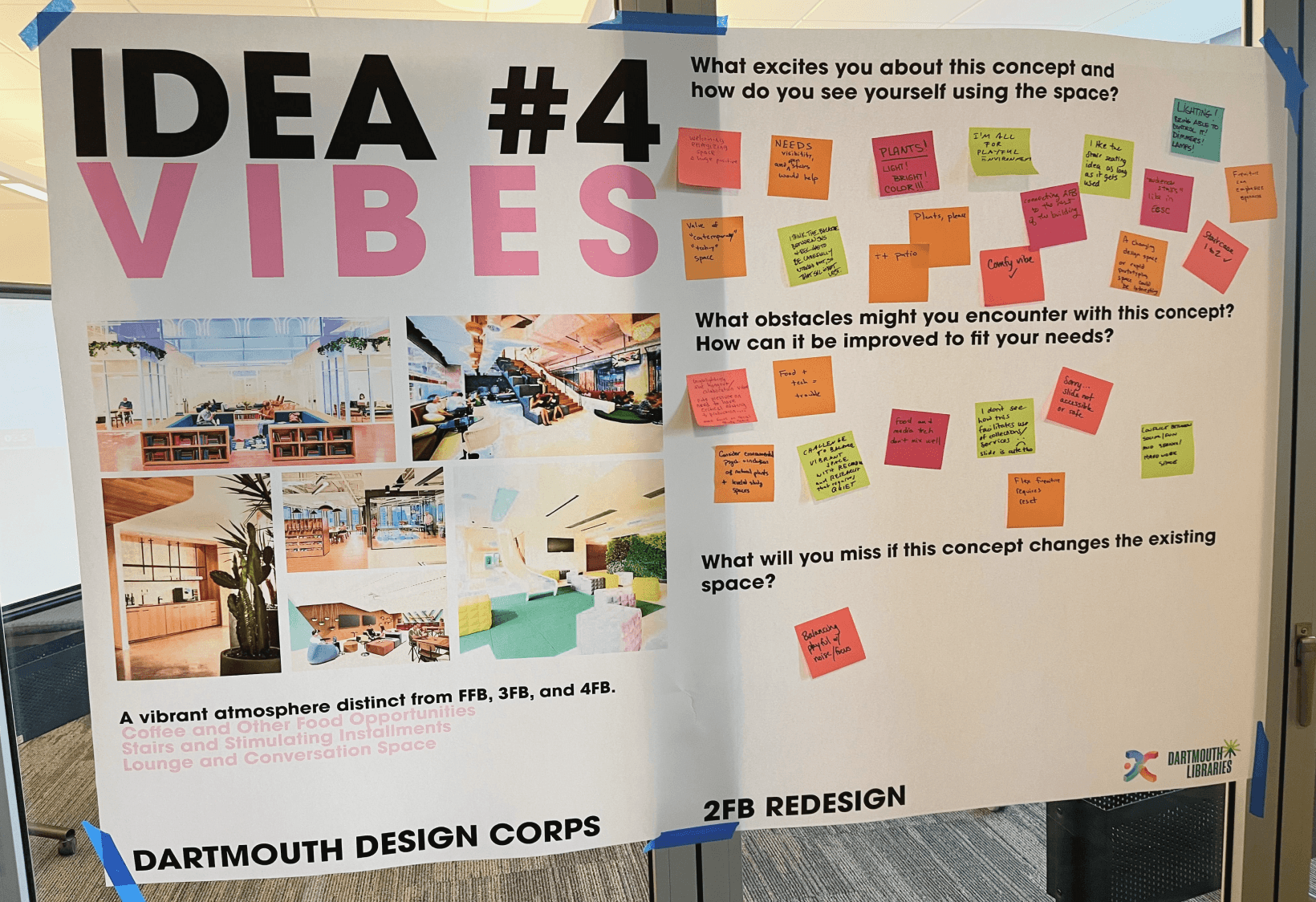
We presented these concepts in two formats: 2 in-person staff workshops, 1 asynchronous workshop and posters installed in the space for student feedback.
Concept feedback
It wasn't until we gave users something specific to react to that they formed clear preferences. Providing tangible concepts unlocked feedback that earlier, more open-ended research couldn't surface. We catalogued everything for Campus Planning in our project report.
Full feedback is available on the report — below are some examples:
Service integration
LANDED
Visible expertise and clear points of contact
Private areas for 1-on-1 exchanges
Multi-purpose spaces usable after hours
GAVE PAUSE
Noise and overcrowding at a shared desk
Worried it would dissolve, not consolidate, expertise boundaries
Integration only works with intentional acoustic and spatial zoning — not as an afterthought.
Open floor plan
LANDED
Light-filled, adaptable spaces
Flexibility for multiple activity types simultaneously
Designated quiet zones alongside open areas
GAVE PAUSE
Enforcing noise gradients without physical cues
Sound-proof recording rooms flagged as non-negotiable
Openness requires acoustic design, not just an open plan. The gradient needs spatial cues to function.
Space character
LANDED
Bright, welcoming, contemporary aesthetics
"Techy" but approachable atmosphere
Collections and services as the spatial anchor
GAVE PAUSE
Mixing food service with technology or maps
Playfulness competing with scholarly focus
Character serves the work or competes with it. The floor's identity should feel deliberate, not decorative.
PROJECT CONTRIBUTIONS
End-to-end research —
from interviews to impact.
Contributed across the project's final two terms — from synthesizing findings to facilitating workshops and translating user insight into actionable spatial recommendations for institutional stakeholders.
Multi-method research
Interviews, surveys, and design charrettes — triangulated to surface findings that no single method could have produced alone.
Workshop facilitation
Led concept validation sessions with staff and students, collecting and synthesizing qualitative and quantitative feedback on proposed spatial designs.
Institutional impact
Delivered a report that reached Campus Planning Operations, triggering the architect-led feasibility study underway — the first formal step toward renovation.
LEARNINGS + TAKEAWAYS
What this project
taught me.
Change requires a reframe, not just evidence
Several staff members pushed back on the redesign concept — not because they disagreed with the findings, but because the change felt too large to be worth it. Presenting data alone didn't move them. I learned to anchor the conversation in what they already wanted, then show how the redesign delivered it. Evidence opens the door; framing gets you through it.
The hardest part of research isn't finding the answer — it's making the answer feel possible.
Delight and accessibility aren't competing values
Early brainstorming produced some genuinely exciting concepts — until user conversations revealed that some of them would quietly exclude people with different physical or cognitive needs. We'd been designing for delight without accounting for who gets left out of it. That recalibration changed not just this project, but how I approach all of them.
Design for everyone who uses the space — not just the person you pictured when you had the idea.
Spatial design is UX design with different constraints
I hadn't worked on a physical space before. The research process was familiar — interviews, synthesis, concept testing — but the design vocabulary was entirely new. Working through information architecture for a room rather than a screen forced me to rewire skills I thought I knew. The transfer was harder and more rewarding than I initially expected.
The skills translate. The application demands something new of them.